
When Were Baby Monitors Invented?
Introduction
In today's parenting, baby monitors have become an indispensable tool for parents. With the continuous advancement of technology, these devices are no longer just about helping parents pay attention to their babies' sleep; they also offer a series of functions to help monitor their babies' safety and health. From real-time video streaming to temperature monitoring, sound detection, and even breathing tracking, baby monitors give parents peace of mind, allowing them to take care of their children.
But have you ever wondered when were baby monitor was invented? How did baby monitors evolve from simple sound amplifiers into the complex devices we rely on today? In this article, we will take a close look at the history of baby monitors, from their initial invention to technological advancements, which have changed the way parents care for their children.
The Invention of the Baby Monitor (1937)
The invention of the first baby monitor is actually tied to a tragic event. In 1932, a baby was kidnapped from the Lindbergh family’s nursery. This incident deeply affected Eugene F. McDonald, the president of Zenith Radio. Wanting a way to better monitor his own child’s safety, McDonald began experimenting with a simple system to listen in on what was happening in his daughter’s room without having to go inside.
McDonald’s idea was backed by Zenith’s engineers, and together, they created the first baby monitor system. This device was composed of two main parts:
- “Guardian Ear”: It is a transmitter that designs a condenser microphone in the shape of an ear and can amplify the faintest sounds. Use the "Guardian Ear" by placing it beside the crib to capture the sounds in the baby's room.
- “Radio Nurse”: The receiver is designed to be as beautiful as a nurse, fashionable and full of futuristic feel. It transmits sound from the baby's room to the location of the parents or caregivers by using radio signals.
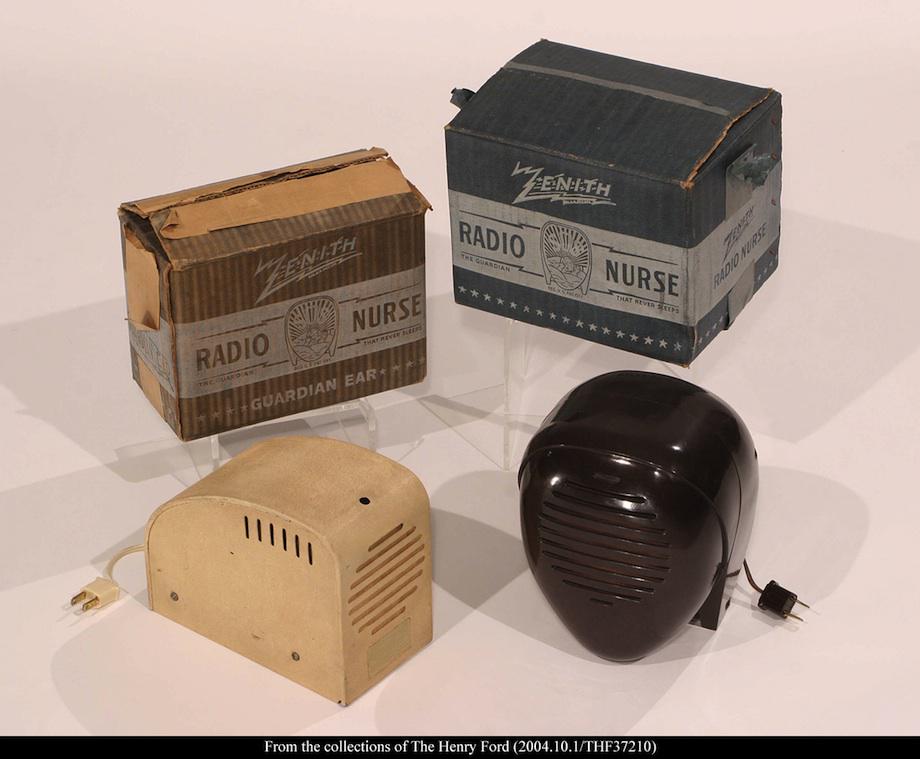
Although this system is an incredible innovation, it also has some drawbacks. This device is expensive to build and is highly susceptible to radio signal interference, which means it sometimes randomly receives irrelevant broadcasts. These restrictions prevented it from being widely used or adopted, although it was even exhibited at the Whitney Museum of American Art’s annual sculpture exhibition that year.
The Evolution of Baby Monitors: From Sound Monitoring to Modern Technology
As technology advanced, so did the capabilities of baby monitors. The Radio Nurse was just the beginning, offering parents basic sound amplification. But as time passed, baby monitors evolved to provide a more comprehensive range of features, greatly improving the parenting experience.
- From sound to video: Initially, baby monitors could only transmit sound, but with the introduction of video technology, parents are no longer limited to hearing their children; they can also see them. This adds a brand-new layer of information, making it easier for parents to ensure that their children are safe and comfortable.
- More stable signal and Wi-Fi integration: Modern non-Wi-Fi baby monitors enhance signal stability. Many baby monitors even integrate Wi-Fi. Parents can remotely monitor their children via smartphones even when they are not at home.
- Two-way communication: Today's monitors offer two-way communication, allowing parents not only to hear their children but also to talk to them. This feature enables parents to comfort their children with their voices even when they are out of sight.
- Temperature monitoring & night vision: Nowadays, many baby monitors are equipped with temperature sensors to ensure that the baby's room is at a comfortable level. In addition, night vision enables parents to check on their children in the dark without disturbing them.
- Breathing and movement monitoring: Some high-end models also offer breathing and movement detection. Some baby monitors are equipped with wearable devices that can track the baby's heart rate and breathing patterns, making parents feel more at ease. There are also some devices that monitor the movements of babies. If any abnormal situation occurs, they will alert the parents.
- Smart Applications & Analytics: The latest generation of baby monitors includes smart applications that allow parents to analyze their baby's sleep patterns, activity levels, and other important data. These applications offer additional support to parents and provide insights into their children's health and habits.
All of these advancements have turned baby monitors from simple audio devices into intelligent assistants that help parents take better care of their children.
Choosing Between Modern Wi-Fi Baby Monitors and Non-Wi-Fi Devices
Today, baby monitors come in two main types: Wi-Fi-enabled monitors and non-Wi-Fi devices. Both have their unique benefits, and the choice between them depends on your family’s needs.
- Wi-Fi baby monitor: These devices use your home's Wi-Fi network to transmit video and audio signals to your smartphone or tablet. Wi-fi-enabled monitors typically offer higher resolution, remote viewing without distance limitations, and other smart features. These are the ideal parents who need to remotely monitor their children, especially when they are not at home.
- Non-wi-fi baby monitors: These monitors typically use radio waves or digital signals to transmit audio or video. They are simpler, more reliable and less likely to be disturbed. Non-wi-fi models are very suitable for families that do not need to remotely monitor their children.
When choosing a baby monitor, there are a few things to consider:
- Budget: Wi-Fi monitors usually come at a higher price point, while non-Wi-Fi monitors are more affordable.
- Features: If you need video, remote access, or extra features like temperature sensors, a Wi-Fi monitor is probably the way to go. But if you just want to keep an ear on your baby, a non-Wi-Fi monitor should be more than enough.
- Usage: If you’re planning to check on your baby when you’re out of the house, a Wi-Fi monitor will make that easy. If you just need a simple, reliable monitor for home use, a non-Wi-Fi option might be the better choice.
If you're leaning towards a non-Wi-Fi monitor, we recommend our JA2216 Baby Monitor. It offers a secure 2.4GHz FHSS connection, allowing you to monitor your baby from up to 1,000 feet — with no app or internet needed. It also features a 5” LCD screen, remote pan, tilt, and zoom, plus night vision and two-way talk. Perfect for parents who just need reliable, simple monitoring.
Conclusion
From the invention of the Radio Nurse in 1937 to today’s advanced baby monitors, the evolution of these devices has greatly changed the way we care for our babies. Today’s monitors offer more than just sound amplification – they now include video, temperature monitoring, two-way communication, and much more. Whether you choose a Wi-Fi monitor or a non-Wi-Fi model, there’s a monitor that fits your needs, making parenting just a little bit easier and a whole lot more reassuring.